
Not every record exists to provide comfort. Some are created to unsettle, to challenge, and to expose the quiet truths people spend years avoiding. That philosophy defines Infinity Fall III, the latest three-track EP from WATCH ME DIE INSIDE, an artistic project built around psychological exploration rather than easy entertainment. Through its interconnected songs, “Uneasy,” “Boring,” and “Infinity Fall III,” the release examines the internal narratives that survive long after reality has exposed them as illusions. It is not an EP about death, despite its provocative imagery. Instead, it is an uncompromising examination of identity, self-deception, and the dangerous comfort of refusing to confront uncomfortable truths.
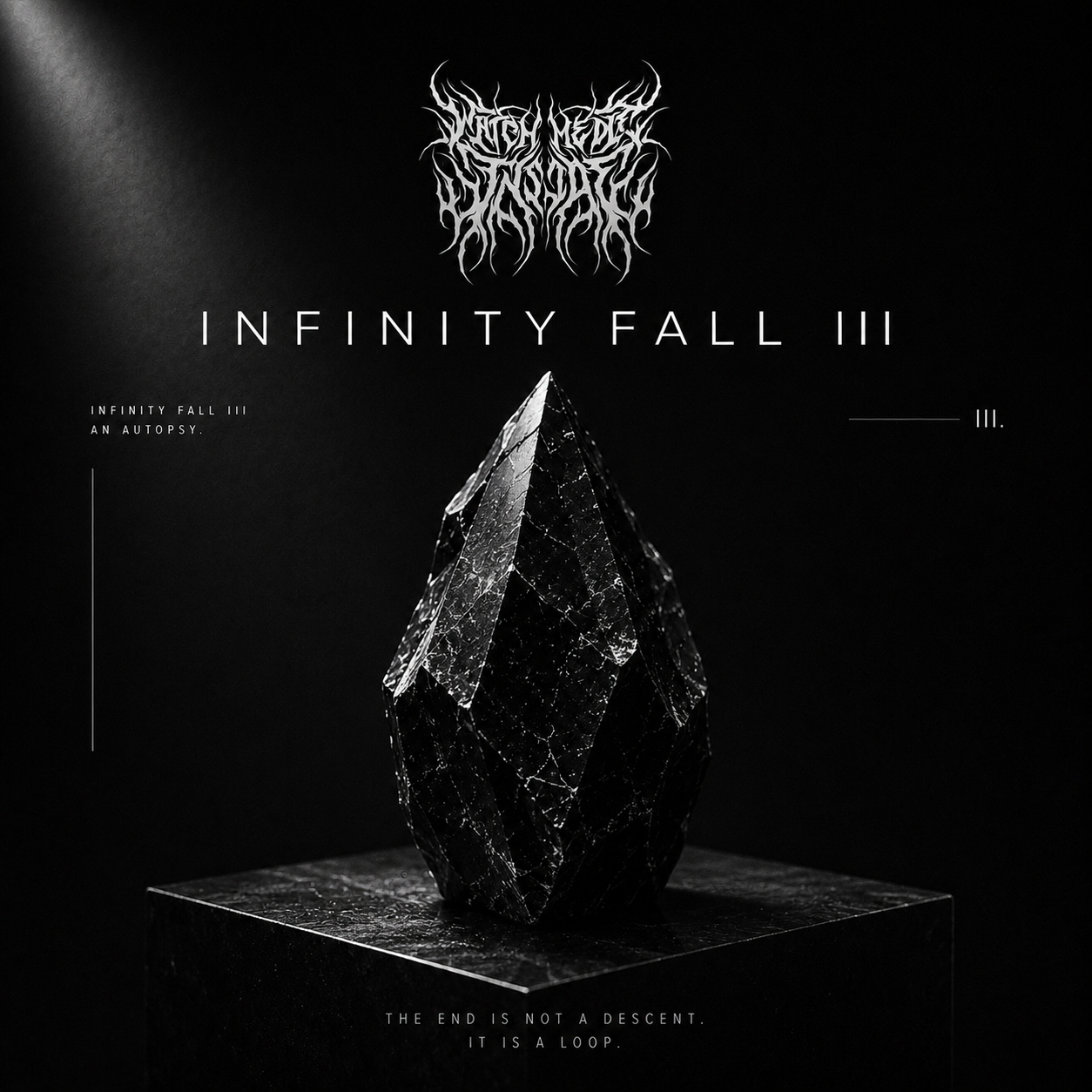
The project’s central idea is deceptively simple. Every certainty, no matter how reassuring, deserves to be questioned. Rather than accepting long-held beliefs as permanent, Infinity Fall III invites listeners to dissect them piece by piece, asking whether the stories we tell ourselves genuinely protect us or merely prevent us from changing. The EP does not offer answers or reassurance. Instead, it functions like a psychological autopsy, carefully exposing emotional wounds that continue to shape behaviour long after they should have healed. It is music designed not to soothe anxiety but to examine where that anxiety originates.
Each of the three tracks represents a distinct stage within that descent. “Uneasy” captures the constant tension of a mind that has lost confidence in its own thoughts, creating an atmosphere where certainty becomes increasingly difficult to trust. Rather than presenting anxiety as sudden panic, the song explores the quieter psychological instability that gradually erodes confidence from within. Layers of cinematic instrumentation, shifting dynamics, and emotionally charged performances reinforce that sense of internal conflict, drawing listeners directly into the fragile mental space the music seeks to explore.
The second chapter, “Boring,” shifts the focus toward routine and emotional stagnation. Here, WATCH ME DIE INSIDE argue that the greatest threat to personal growth is not necessarily suffering but comfort itself. Safety, predictability, and familiarity slowly become their own form of imprisonment, replacing curiosity, purpose, and ambition with quiet resignation. Rather than depicting boredom as simple inactivity, the song presents it as a subtle psychological force capable of slowly dismantling identity without attracting attention. It is one of the EP’s most thought-provoking moments, transforming an everyday experience into something unexpectedly unsettling.
The title track, “Infinity Fall III,” serves as the project’s emotional and philosophical conclusion. This is not a song about redemption or triumphant victory. Instead, it captures the difficult decision to embrace uncomfortable truth rather than comforting illusion. The clarity offered here comes at a cost, forcing listeners to confront themselves without distraction or false optimism. By refusing to provide a conventional emotional payoff, the song remains entirely consistent with the EP’s broader artistic philosophy. The destination is not happiness but awareness.
Musically, Infinity Fall III combines modern metal with cinematic ambition, blending crushing riffs, atmospheric textures, dramatic dynamics, and carefully controlled tension into a sound that feels both emotionally overwhelming and remarkably disciplined. Heavy instrumentation exists alongside moments of silence and restraint, allowing contrast to become one of the project’s most effective storytelling tools. Rather than relying solely on aggression, WATCH ME DIE INSIDE understand that absence can often carry as much emotional weight as volume. Every production choice contributes to the larger psychological narrative, creating a listening experience that rewards full immersion rather than casual background listening.
The visual identity surrounding the EP reflects that same commitment to conceptual consistency. Instead of relying on obvious symbolism, the project introduces an abstract Artifact emerging from darkness, refusing to explain exactly what it represents. Like the music itself, the imagery asks questions rather than providing interpretations, encouraging audiences to participate actively instead of consuming passively. Every teaser, visual element, and design decision belongs to a larger artistic universe where ambiguity becomes an essential part of the experience rather than an obstacle to understanding.
Behind the music is Aleph, the creative force responsible for building the broader world of WATCH ME DIE INSIDE. Rather than approaching each release as an isolated project, Aleph constructs an evolving artistic universe centred around what are known as Fragments. Each Fragment documents a different psychological condition, exploring states of emotional collapse, identity loss, resistance, emptiness, and the struggle to continue functioning despite internal disintegration. Multiple Fragments together become an Autopsy, not simply an album or collection of songs, but the careful examination of a psychological wound from multiple perspectives. Within this framework, audiences are not referred to as fans or listeners. They become Witnesses, observing emotional realities exactly as they exist, without softening, sentimentality, or comforting resolution.
That philosophical consistency is what separates WATCH ME DIE INSIDE from many contemporary concept-driven projects. Every lyric, musical decision, visual element, and structural choice serves the same overarching purpose, creating an artistic experience that feels immersive rather than merely thematic. Instead of chasing accessibility through familiar emotional resolutions, the project challenges listeners to sit with uncertainty and resist the urge to immediately explain or resolve what they are experiencing.
With Infinity Fall III, WATCH ME DIE INSIDE deliver an uncompromising work that values honesty above comfort and self-examination above escapism. It is a bold meditation on identity, illusion, and psychological resilience that refuses to flatter its audience or offer convenient conclusions. Instead, it asks something far more demanding: not whether we are prepared to face difficult truths, but whether we have ever truly been awake enough to recognise them.
Connect with WATCH ME DIE INSIDE on
 English